
Charity Fundraising: Systems and Processes for Automated Charity Funding
Fundraising lies at the core of every charity. However, the way we raise funds is constantly changing. This guide is designed to touch on key components of charity fundraising systems and processes that will be key to successful fundraising for your charity. We will also focus on the use of Customer Relationship Management (CRM) systems and how they can help make fundraising much easier to manage, track and improve.
Sources of Charity Funding
Securing reliable funding requires a clear and multi-faceted strategy. Successful charities balance several income streams to help fund the work they do. Understanding the different methods is the first step toward financial stability, growth, and a successful charity fundraising strategy.
According to the latest data from the VCSE Barometer, grants from trusts and foundations remain the largest funding source in the sector. If you’re not already applying for grant funding, this is a potential income stream you don’t want to miss out on.
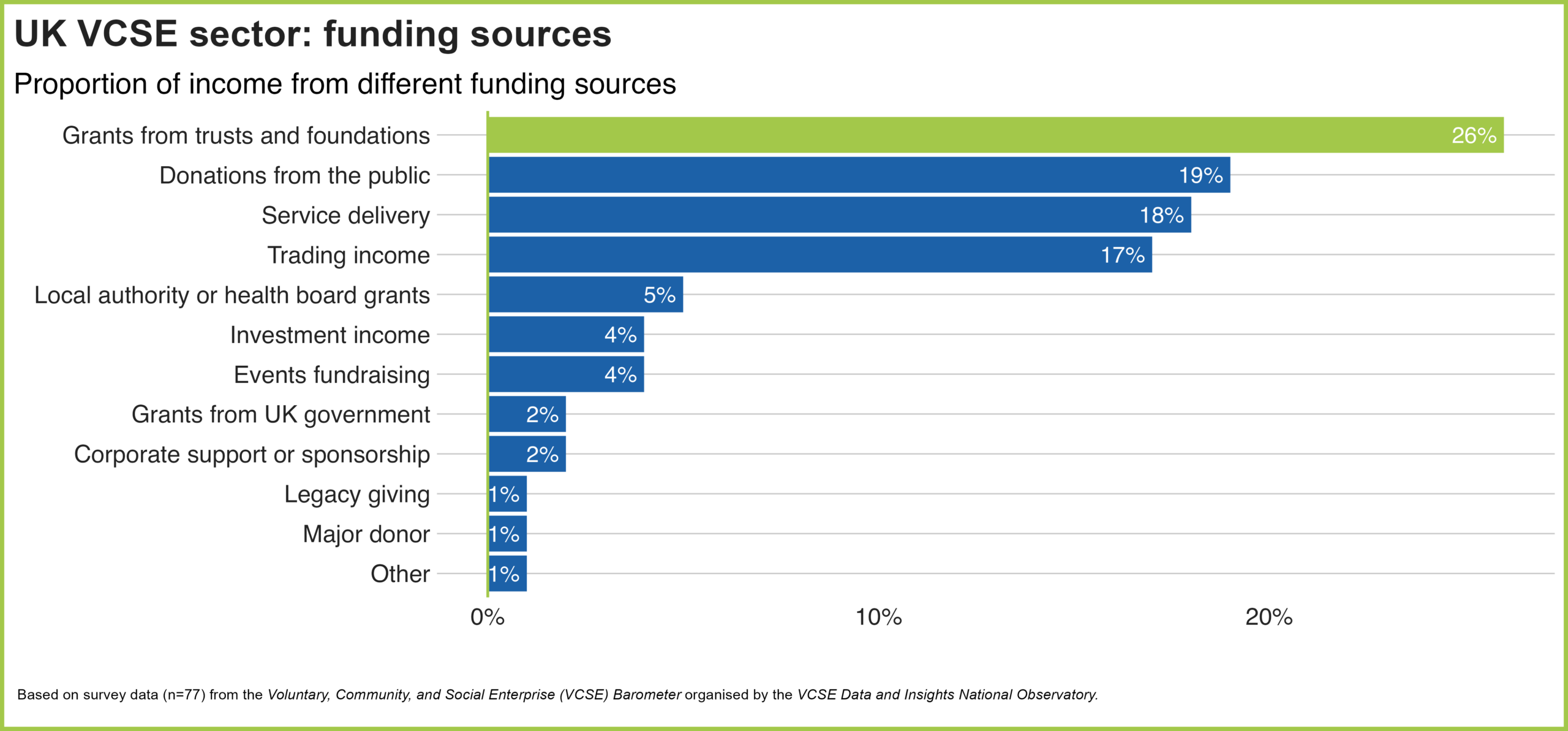
Second to grant funding are donations from the public. While this can be a prosperous source of funding, raising donations is not a simple task. Let’s explore these funding sources in more detail below.
Charity Grant Funding
Grant funding is one of the most utilised funding sources for charities. However, grant applications require careful planning and research. Large charity organisations may have a dedicated team for grant applications, that is how important they are.
When thinking of applying, you must first identify suitable organisations whose mission aligns with your work. Applying for grants unrelated to your charity’s mission will likely result in rejection. Specific and relevant applications have a much higher chance of success. Choosing the right organisation for your grant application is paramount, especially for smaller charities.
Foundations, as well as organisations, continue to increase their grant-making expenditure even amidst high inflation and economic uncertainty, as recently reported by the Association of Charitable Foundations. This means that there may be more opportunities for you to acquire funding.
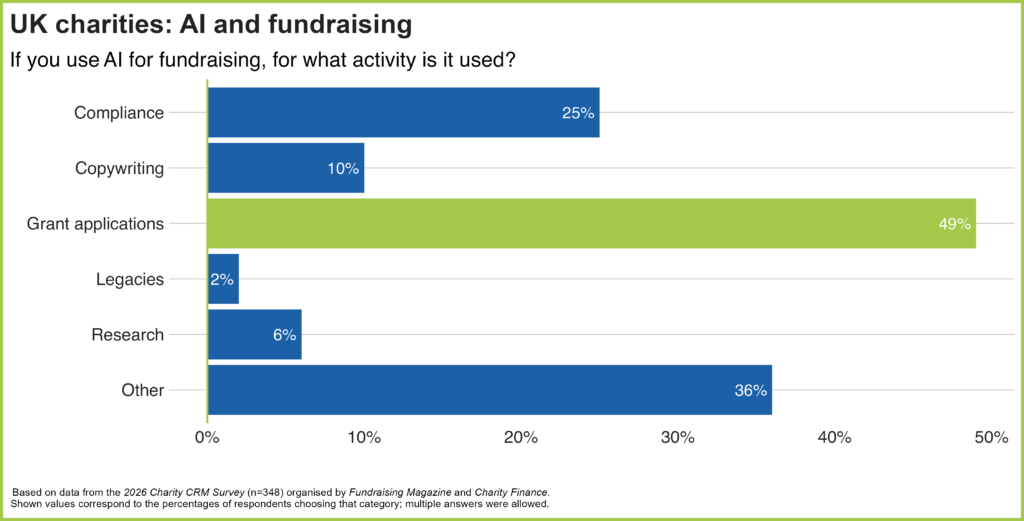
Once you’ve selected the organisations or foundations for your applications, you need to develop strong, evidence-based proposals. Research by the 2026 Charity CRM Survey suggests that almost half of UK charities may be using AI for grant applications. While this tool can help make the process quicker, we always recommend that you add the human and emotional touch. Your charity exists for an important reason and you must ensure this is accurately communicated.
Donations from the public
As seen from one of our previous figures, the next biggest source of charity funding comes from public donations. Raising donations can be a complex task, involving strategic planning and requiring excellent record-keeping. By following these best practices, you can grow your donor base sustainably and help your charity build an effective, results-driven strategy.
Your charity will likely have multiple sources of donations from the public, such as:
- monthly recurring payments
- one-off donations by card
- cash donations
- cheques
- payroll giving
- gift aid
Tracking all of these donations and monitoring the activity of each donor can be a large mountain of work. That’s why we recommend employing a CRM, like Beacon, to manage payments, automatically update supporter information, and create accurate reports of your campaign success.
But managing payments isn’t the charity fundraising strategy. Your organisation must come up with methods to increase giving through new donors and existing donors.
How can your charity engage new donors?
Storytelling is one of marketing’s best tools, and your charity is sure to have a powerful story. People give money because they connect with a cause. Your charity’s mission is how you connect with your audience, so use compelling evidence of your impact to get new donors on board.
Whats more, we have a wealth of channels available to offer diverse engagement methods. This could include social media campaigns, local events, email campaigns or personalised letters and printed resources. You can take advantage of specialised platforms, like Mailchimp, to manage donor segmentation and track email campaign performance.
In addition to digital marketing, your fundraising team may organise events for your charity. This is the perfect opportunity to start a relationship with donors in person. Encourage donors to connect emotionally with your charity and the team that works for the organisation. In-person fundraising can also be conducted with door-to-door visits and representatives in town centres. Where, again, your team can make strong connections and impressions on new and potential donors.
Donor Retention is key for charity fundraising
Retaining existing supporters is usually more cost-effective than finding new ones. Focusing on retention ensures a steady stream of funding for your cause. Building relationships with donors helps to nurture loyalty and is an essential task for all charity fundraising strategies. With the right tools, your charity can create specific segments to target existing donors in accurate and personal ways to encourage repeat donations.
Supporter engagement is built on consistent and meaningful communication. For example, inviting them to virtual events or exclusive briefings can deepen their connection to the charity’s mission. Taking advantage of your CRM, you can obtain data on your top donors. Offering them personalised thank-you notes or awards for their continued generosity. Creating opportunities for your supporters to feel involved in your charity’s work can help to retain them.
You can also create a supporter journey map that visualises the entire donor lifecycle. By understanding your main touchpoints, you can identify moments of potential drop-off. You can then plan specific interventions like email reminders or SMS campaigns, which can be streamlined using specialised platforms like Mailchimp. This ensures the supporter experience is always positive and seamless.
Gaining Legacy Funding
All of your efforts to build relationships with your donors can also provide a foundation for future giving. While legacy giving makes up only 1% of charity fundraising, stability comes from diverse income sources like this. This involves encouraging donors to leave a legacy through wills or trusts. These gifts provide long-term income, which will become even more important for charities as the legacy income in the UK is forecast to rise to £5bn by 2029. Effective donor relationship management is crucial to retaining these supporters.
Partnerships
Much like legacy giving, partnerships typically generate 1% of all charity funding. However, this does not mean it is an opportunity to be overlooked. Building relationships with businesses and corporate organisations can help your charity diversify its income, access new resources and reach audiences you may not otherwise engage with.
Beyond financial support, partnerships can provide valuable expertise, staff volunteering, pro bono services and increased public awareness. When developed strategically, they can become long-term relationships that support your charity’s mission, strengthen its reputation and create a greater impact.
Business-charity partnerships
Successful business-charity partnerships are built on shared values and mutual benefits, rather than simply asking businesses for donations. You can start by identifying organisations whose products, services, employees or customers align with your charity’s cause, then develop collaborative initiatives that offer value to both parties. These partnerships might include:
- employee fundraising challenges,
- matched donations,
- volunteering days,
- sponsorship of events, or
- in-kind contributions such as professional expertise, equipment and services.
In return, businesses can strengthen their community presence, engage employees, demonstrate their social responsibility and build positive relationships with customers. By creating clear objectives and communicating the impact of your work together, you can turn one-off charitable contributions into meaningful, lasting partnerships.
Corporate partnerships
Corporate partnerships take this approach further by establishing a strategic relationship between a charity and a company, with shared goals that extend beyond individual donations or fundraising campaigns. Your charity should take the time to understand a company’s Corporate Social Responsibility (CSR) priorities, sustainability commitments and business values before proposing opportunities that align with them. This could involve a multi-year fundraising agreement, a joint community initiative, employee volunteering programmes or sharing specialist knowledge and resources to address a specific social challenge.
The benefits can include more predictable funding, access to new networks, improved organisational capacity and greater visibility. Your corporate partners can demonstrate tangible social impact and strengthen employee engagement. As highlighted by the principles of effective business-charity collaboration, building trust, maintaining open communication and measuring shared outcomes are essential to developing partnerships that deliver lasting value for both organisations.
Automating Your Charity Fundraising Strategy
We’ve already briefly mentioned how a CRM can transform your charity’s way of working. These automation tools are vital for modern fundraising so that you can manage large amounts of data efficiently, easily connect with donors, and maximise your impact. Here are some ways that you can automate your charity’s fundraising efforts and the benefits you’ll gain from these tools.
Managing Grant Applications
While AI can be helpful for producing proposals at the application stage, managing grant funds is far more complex. Usually, part of your proposal will cover how you will manage the funds, track progress and measure success. Using manual systems can be exrremely time consuming and a waste of resources.
One approach to manage your grant funds and have accurate reporting is to implement processes in your CRM. An effective CRM can track where the funds are allocated, how the project is progressing and offer collaboration across all of your teams to monitor success. This will be largely automated, reducing time costs in monitoring, and can help highlight any issues before they become critical.
Donor Management
Accurate donor data management is essential. Tracking interactions, interests, and giving history of each donor is essential to offering them a personalised experience with your charity. A dedicated system helps you store and manage all of this data automatically.
But why is data on donors important? The reports that your CRM can generate based on your donor data will help your charity with future prospecting. You will be able to identify factors like demographics and online behaviour that respond the best to your campaigns. It can also help segment your audience into more specific groups so that every campaign is optimised accurately for optimal results.
Gift Aid
Checking eligibility and submitting claims on the different types of Gift Aid requires a lot of admin. Costing you both time and resources which could be directed at more important tasks, like increasing your donor pool. However, you don’t want to miss out on the potential income from Gift Aid on regular giving, sponsored events, and the small donations scheme.
With a specialist CRM, like Beacon, you can automate your charity’s Gift Aid claims. Fully recognised by HMRC, your CRM can perform auto-eligibility checks and submit the claims automatically, saving you a lot of time.
Email Marketing
Email marketing is an essential method of communication with your audience. But manually managing contacts and underdeveloped audience segments can cost you time, resources and successful fundraising. That’s why it is even more important to implement a CRM system to help automate your email marketing.
An effective CRM will allow you to segment your audience accurately to send them highly targeted content. You can track which campaigns resonate best with specific groups to optimise future campaigns. While also automating emails that confirm payments, ticket purchases, and charity updates. However, the ease of this automation depends on the CRM and how challenging it is to integrate it with your digital marketing tools.
The recent 2026 Charity CRM Survey shows that the ability of CRMs to help you with digital marketing varies quite a lot across different software tools.
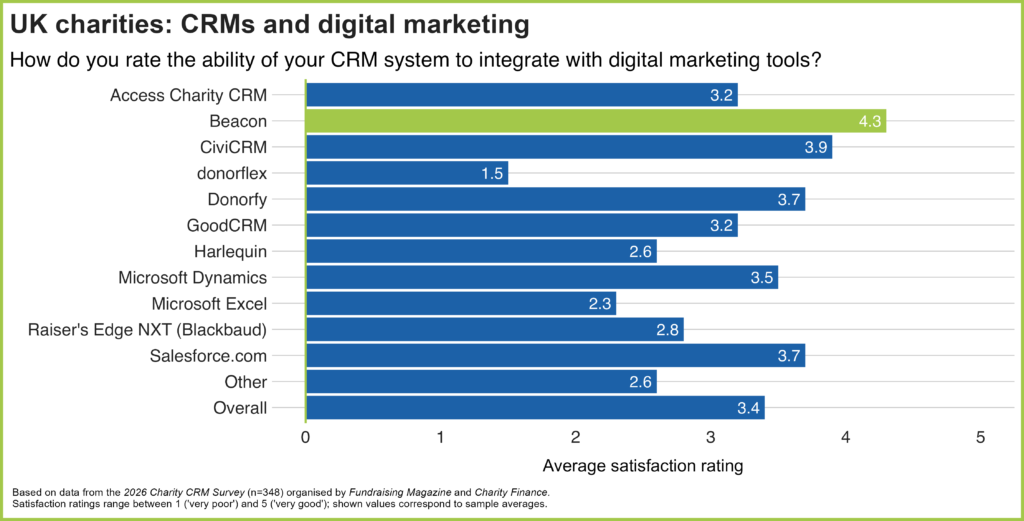
Beacon CRM has been consistently rated the highest in terms of its ability to integrate with digital marketing tools. With integrations like Mailchimp, SendGrid, and Dotdigital, your charity can manage all of the important tasks in one place. Virtual Blue Bird can help you implement specific Beacon functionalities to ensure your marketing efforts are efficient and measurable.
How can automation reduce costs?
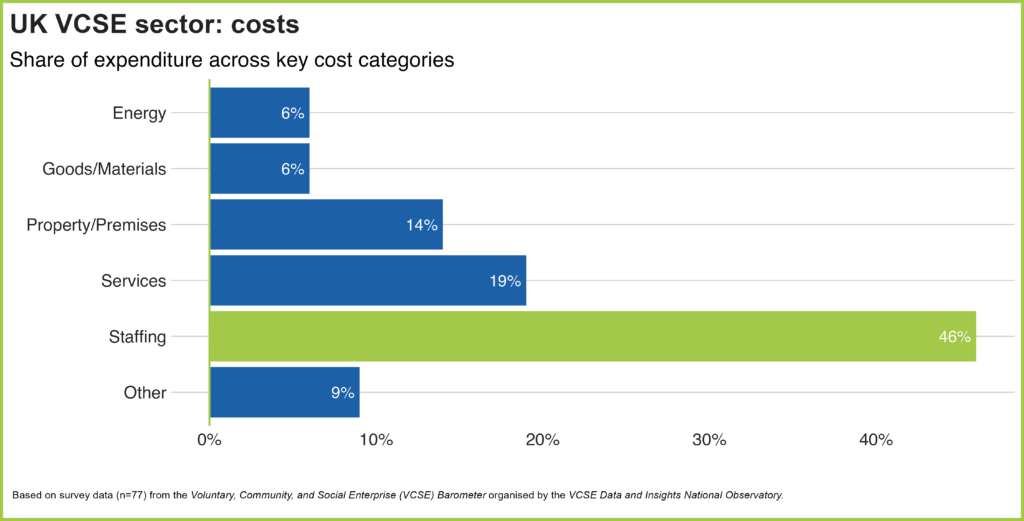
Automation handles repetitive tasks such as data entry and follow-up emails, as well as connecting all of your platforms in one place. This frees up staff time, which can lead to significant cost reduction. According to the recent VCSE Barometer report, staffing constitutes almost half of the total expenditure in the sector.
Instead of spending hours on administrative work, your staff can focus on high-value activities. This can include launching new campaigns to attract new donors and campaigns to target existing donors to improve retention. Therefore, a CRM makes your existing team much more productive and able to focus on the most important tasks.
Not only can your team save time, but the systems connected to your CRM can also help save costs with external providers. For example, Beacon integrates with accounting software like Xero and Sage to automate accounting data. This can reduce the amount of time an accountant spends cleaning your payment data or obtaining records from multiple sources.
Should you implement automation in your CRM yourself?
While the idea of automation is appealing, implementation can be complex. A CRM system needs careful setup to work correctly. A lot depends on the system itself: according to the 2026 Charity CRM Survey, CRMs noticeably differ in their ability to help you automate your business processes. In this regard, Beacon CRM was rated the highest.
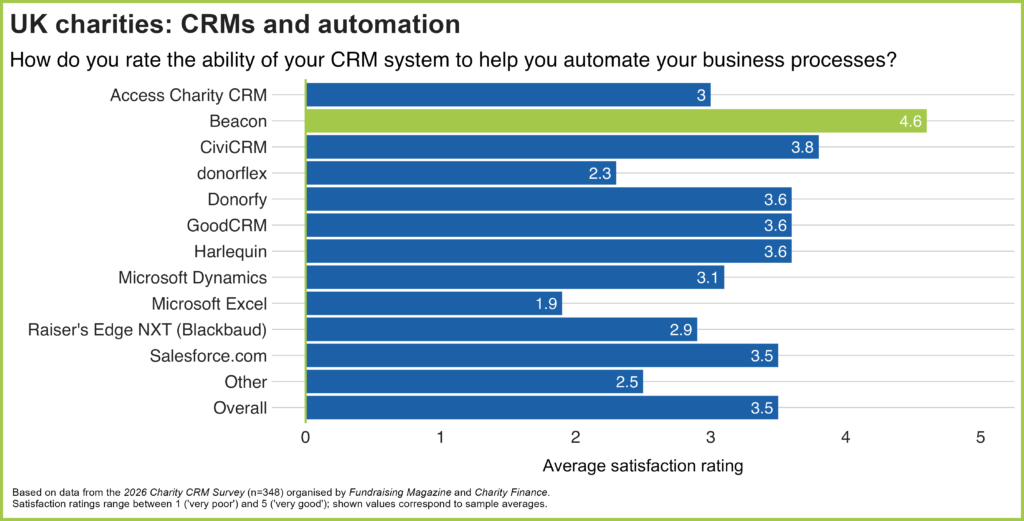
For reliable results, professional expertise can be very useful, as it allows you to save time and resources for more critical tasks. From our experience with charity clients at Virtual Blue Bird, organisations often require strategic support to fully implement available automation functionality, or tailor it to their specific needs. This becomes even more relevant for flexible CRMs such as Beacon, as they provide a variety of add-ons and integration features that may overwhelm internal teams without a clear roadmap.
Contact the Virtual Blue Bird CRM implementation experts today. We offer services to migrate and customise Beacon CRM for your charity’s needs. Plus, we can add integrations like Mailchimp for email marketing and Fundraise Up to give your charity the perfect tools to accept payments and increase donor retention rates.